Most reusable insulated water bottles are made from several materials rather than one.
A typical vacuum-insulated bottle uses 304 or 316 stainless steel for the inner liner, stainless steel for the outer shell, PP plastic for the lid, and silicone for the sealing gasket. Some models also include plastic, silicone or stainless steel drinking components.
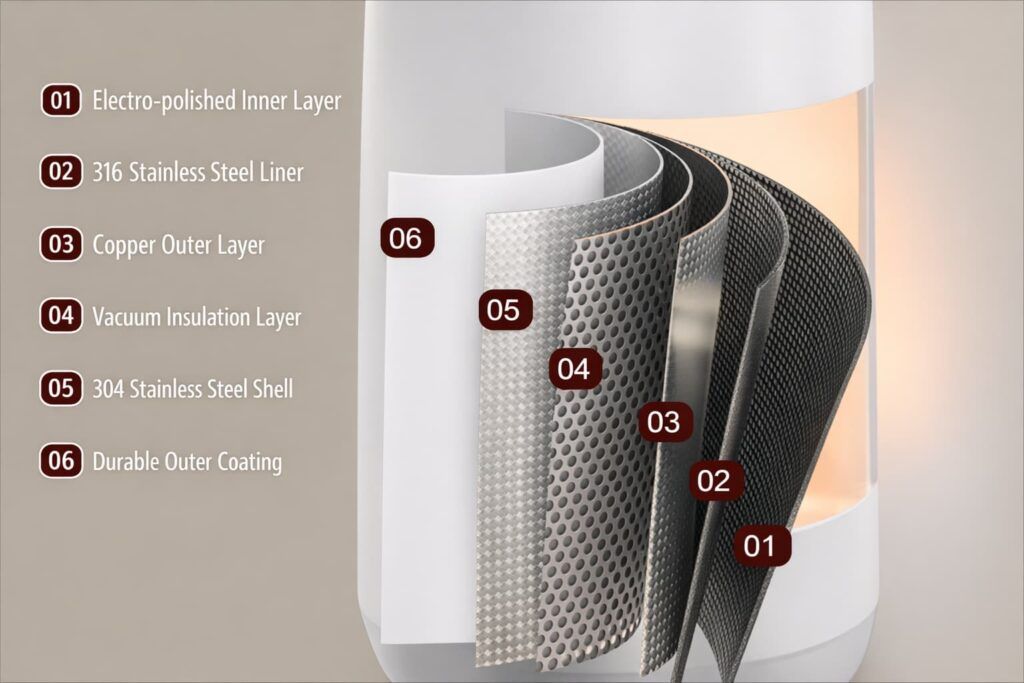
The insulation itself is usually not foam or another solid filling. In a stainless steel vacuum bottle, most of the air is removed from the sealed space between the inner and outer walls. This vacuum layer is what reduces heat transfer.
This article explains what each part is made of, why different materials are used, and what buyers should confirm before ordering insulated bottles.
Insulated Water Bottle Materials at a Glance
| Bottle Part | Common Materials | Main Function |
|---|---|---|
| Inner liner | 304 or 316 stainless steel | Holds the beverage and resists corrosion |
| Outer shell | 201 or 304 stainless steel, depending on the specification | Provides shape, strength and exterior protection |
| Insulating layer | Vacuum gap between the two walls | Reduces heat conduction and convection |
| Lid body | PP plastic, stainless steel or a combination of materials | Opens, closes and supports the drinking function |
| Sealing gasket | Silicone | Creates a tight seal between the lid and bottle |
| Straw or spout | Plastic, silicone or stainless steel, depending on the design | Provides the required drinking function |
| External finish | Powder coating, spray painting, plating or bare stainless steel | Changes appearance, grip and surface durability |
The exact material combination depends on the bottle design, intended use, target market and product specification.
What Is the Inner Liner Made Of?
The inner liner is the part of the bottle that directly contacts the beverage. It also forms one side of the double-wall vacuum structure.
Stainless steel is commonly used because it provides a practical combination of corrosion resistance, durability and manufacturability. When the selected material and finished product meet the applicable requirements, suitable stainless steel grades can be used for food-contact drinkware.
The two most common options are 304 and 316 stainless steel.
304 Stainless Steel
SUS304, also known as 18/8 stainless steel, is widely used for everyday insulated bottles and tumblers.
It provides:
- Good corrosion resistance for normal daily use
- Reliable durability
- A practical balance between performance and cost
- Good suitability for water and common beverages
For most everyday insulated water bottles, 304 stainless steel is a practical inner-liner material.
316 Stainless Steel
SUS316 contains molybdenum and generally offers greater resistance to chloride corrosion than 304.
It may be selected for:
- Premium drinkware
- More demanding corrosion environments
- Projects requiring a higher material specification
- Products positioned around upgraded material performance
However, 316 is not automatically necessary for every insulated bottle. For normal daily drinking requirements, 304 stainless steel is widely used.
For a more detailed comparison, read our guide to 304 vs. 316 stainless steel water bottles.
What Is the Outer Shell Made Of?
The outer shell forms the visible exterior of the bottle. It provides structural support, protects the inner liner and creates the final bottle shape.
Unlike the inner liner, the outer shell does not normally contact the beverage. This means its material requirement may differ from that of the inner wall.
Common outer-shell options include:
304 Stainless Steel Outer Shell
An outer shell made from 304 stainless steel provides better corrosion resistance and keeps the inner and outer material specifications consistent.
It may be selected when:
- The buyer requires both walls to use the same grade
- Higher exterior corrosion resistance is needed
- The product specification or target market requires 304 stainless steel throughout the bottle
201 Stainless Steel Outer Shell
201 stainless steel may be used for the non-contact outer shell of some insulated bottles. It provides sufficient forming strength for certain applications and can help control material cost.
However, buyers should not assume that an “all-stainless-steel” bottle uses the same grade for every component.
The quotation and product specification should state separately:
- Inner liner material
- Outer shell material
- Inner bottom material, where relevant
- Any stainless steel components in the lid
A supplier saying that a bottle is “made of 304 stainless steel” does not always explain whether 304 applies only to the inner liner or to both walls.
What Is the Insulating Material Inside the Bottle?
In a standard stainless steel vacuum-insulated bottle, the insulating layer is normally a vacuum rather than a solid material.
The bottle has an inner stainless steel liner and an outer stainless steel shell. These two walls are joined to create a sealed cavity. During production, air is removed from that cavity, and the evacuation opening is sealed.
With much less air between the walls, heat has fewer paths through which it can move. This reduces heat conduction and convection, helping the bottle keep its contents hot or cold.
Some bottle structures also use a getter inside the sealed vacuum cavity. Its purpose is to absorb residual gases and support vacuum stability. It is located between the two walls and does not contact the beverage.
The vacuum layer can fail if the welded seal or evacuation seal is damaged. For this reason, welding quality, vacuum processing and temperature testing are important parts of production.
See the complete insulated water bottle manufacturing process to understand how the two walls are formed, welded and vacuum sealed.
What Are Insulated Bottle Lids Made Of?
An insulated bottle lid normally combines several materials because the lid must provide sealing, opening, carrying and drinking functions.
PP Plastic
PP, or polypropylene, is commonly used for lid bodies because it is lightweight, durable and suitable for injection molding.
It can be formed into:
- Screw lids
- Flip lids
- Straw lids
- Carry handles
- Locking components
- Internal lid structures
The exact resin and food-contact requirements should be confirmed for the target market.
Silicone Sealing Gaskets
A silicone gasket is normally installed between the lid and the bottle mouth. When the lid is closed, the gasket is compressed and helps prevent leakage.
Silicone may also be used for:
- Drinking straws
- Spout components
- Flexible valves
- Protective parts
A bottle being made from stainless steel does not mean that its entire lid is metal. Plastic and silicone are normally required to create the lid’s functional and sealing components.
Stainless Steel Lid Components
Some lids use stainless steel for an external cover, internal contact component or decorative element. These components can improve appearance and help the lid match the bottle body.
The lid may still contain plastic and silicone parts even when its exterior looks like stainless steel.
What Is the Outside of an Insulated Bottle Made Of?
The visible outer surface may be bare stainless steel or covered with a surface finish.
The finish changes appearance, grip and resistance to daily wear, but it does not create the vacuum insulation.
Common options include:
- Bare or brushed stainless steel: Maintains the natural appearance of the metal.
- Powder coating: Creates a thicker, durable colored surface with different textures and gloss levels.
- Spray painting: Provides flexible color and visual effects with a smooth surface.
- Plating: Creates metallic colors and reflective decorative effects.
Buyers can review our powder coating service for stainless steel bottles and spray painting finish options when selecting an exterior treatment.
The selected coating should be evaluated separately from the stainless steel grade. A high-quality coating cannot correct the wrong body material, and a suitable stainless steel body does not guarantee that every external finish will provide the same wear resistance.
Are All Insulated Water Bottles Made of Stainless Steel?
No. Insulated bottles can use different material structures.
Stainless Steel Vacuum Bottles
These use separate inner and outer metal walls with a vacuum gap between them. They are commonly selected for reusable bottles because they combine insulation performance with good resistance to impact.
Glass Vacuum Flasks
Traditional vacuum flasks may use a double-wall glass liner inside a plastic or metal protective shell. Glass provides good taste neutrality but is more vulnerable to breakage.
Plastic Insulated Bottles
Some plastic bottles use a double-wall structure or an insulating layer between the walls. They are normally lighter than stainless steel bottles but may have different temperature, durability and application limits.
This page mainly focuses on stainless steel vacuum-insulated bottles because they are widely used for reusable water bottles, tumblers, travel mugs and custom drinkware.
How Can Buyers Confirm the Bottle Materials?
Appearance alone cannot confirm stainless steel grade. A polished 201, 304, or 316 stainless steel surface may look similar.
For a custom or wholesale order, buyers should confirm:
- The stainless steel grade of the inner liner
- The stainless steel grade of the outer shell
- Material thickness
- Lid and straw materials
- Silicone gasket requirements
- Material certificates or supplier records
- Sample approval
- Required third-party testing
At the factory, incoming stainless steel material should be checked before body production. Material, thickness and batch information should be traceable to the proposed order.
A magnet test should not be used as final proof of stainless steel grade. Cold forming, stamping and other production processes can cause austenitic stainless steel to show weak magnetism.
When independent verification is required, buyers can arrange laboratory material analysis on an approved sample or production sample. Review the supplier’s quality control and testing process before confirming the inspection plan.
Material grade, wall specification and lid structure also affect price. Our stainless steel water bottle manufacturing cost guide explains how these choices influence the EXW cost per bottle.
Frequently Asked Questions
Is the space inside an insulated bottle filled with foam?
Usually not in a stainless steel vacuum-insulated bottle. The space between the inner and outer stainless steel walls is evacuated to form a vacuum layer. Some plastic insulated bottles may use a different structure or insulating material.
Are all insulated water bottles made of stainless steel?
No. Insulated bottles may use stainless steel, glass or plastic structures. Stainless steel vacuum bottles are common because they combine durability with effective vacuum insulation.
Is 304 stainless steel suitable for insulated water bottles?
304 stainless steel is widely used for everyday insulated bottle liners because it offers good corrosion resistance, durability and cost efficiency. The material and finished product should still meet the applicable requirements for the target market.
Is 316 stainless steel better than 304?
316 generally provides better resistance to chloride corrosion because it contains molybdenum. However, 304 is suitable for many daily drinking applications. The appropriate grade depends on the intended use, product positioning and budget.
Can 201 stainless steel be used in an insulated bottle?
201 stainless steel may be used for the non-contact outer shell of certain bottles. Buyers should confirm that the inner liner, which contacts the beverage, uses the material grade required by the product specification.
What are insulated bottle lids made of?
Most insulated bottle lids combine PP plastic and silicone. Some designs also contain stainless steel, transparent plastic, straws, spouts, handles or locking components. The exact combination depends on the drinking function.
Final Answer
A typical stainless steel insulated water bottle is made from:
- A 304 or 316 stainless steel inner liner
- A stainless steel outer shell
- A vacuum gap between the two metal walls
- A PP plastic or partly stainless steel lid
- A silicone sealing gasket
- Optional plastic, silicone or stainless steel drinking components
- An external finish such as powder coating, spray painting, plating or bare stainless steel
The vacuum gap—not a thick layer of foam—is the main insulating element in a standard stainless steel vacuum bottle.
For buyers, the most important step is to confirm each component separately. The inner liner, outer shell, lid and sealing parts may use different materials even though the finished product is sold as a stainless steel insulated bottle.